


Cosmos Pet Grooming Academy offers distinct online and in-person pathways aligned to measurable competency outcomes. The online format covers foundational theory, maintenance skills dog grooming course, and flexible pacing with low upfront cost. In-person or hybrid tracks emphasize intensive hands-on labs, supervised live-animal practice, industry-standard equipment, and salon-simulated facilities for client-ready proficiency. Assessments use rubric-driven checkpoints and portfolio evidence rather than seat time. Tuition options and micro-credentials vary by format. Continue for a detailed comparison of curriculum, skills, and suitability.

Why Choose Cosmos Pet Grooming Academy?
With a focus on standardized curriculum and measurable outcomes, Cosmos Pet Grooming Academy presents a structured training pathway for prospective groomers. The institution emphasizes evidence-based techniques, leveraging experienced instructors who deliver consistent competencies across cohorts. Instructional design aligns with industry benchmarks, supporting clear assessment metrics and skill validation. Facilities and virtual resources integrate modern tools to accelerate proficiency while minimizing variability in student performance https://cosmos.petuniverse.com/dog-grooming-course/. Graduates receive documented skills profiles that map to distinct career pathways, facilitating employer recognition and targeted job placement. Administrative systems prioritize continuous improvement through outcome tracking and iterative syllabus updates. The overall proposition is pragmatic: a predictable, scalable training model that appeals to learners seeking efficient, innovation-friendly routes into professional grooming.
Curriculum and Course Content Comparison
The curriculum is evaluated for both theoretical breadth and practical depth, comparing subject coverage, progression, and assessment methods. Emphasis is placed on measurable hands-on skills acquisition, including supervised grooming hours, simulation practice, and competency checkpoints. This comparison highlights where Cosmos aligns with industry standards and where gaps or strengths in applied training emerge.
Curriculum Depth and Scope
One clear metric for evaluating Cosmos Pet Grooming Academy is the breadth and depth of its curriculum compared directly to competing programs: courses cover foundational grooming theory, breed-specific techniques, handling and safety protocols, and salon business essentials, with progressive modules that move students from basic clipper skills to advanced styling and corrective grooming. The curriculum delineates course prerequisites clearly, enabling accelerated pathways for experienced technicians while preserving entry routes for novices. Content balances theoretical frameworks, regulatory compliance, and client management with modules introducing innovative tools and methodologies. Comparative analysis shows a systematic escalation toward advanced techniques, integrated assessment points, and elective specialization tracks. Documentation is modular, update-ready, and designed for continuous improvement, positioning the program as scalable and future-focused without overstating outcomes.
Hands-On Skills Emphasis
Evaluates how Cosmos Pet Grooming Academy prioritizes practical proficiency by comparing hands-on training hours, student-to-instructor ratios, live-animal versus mannequin practice, and supervised clinic shifts against peer programs. The Academy allocates concentrated lab hours with a low student-to-instructor ratio, emphasizing real time demonstrations and iterative skill drills. Curriculum balances mannequin introduction for foundational technique with progressive live-animal sessions under licensed supervisors. Supervised clinic shifts mirror commercial workflows, integrating time management and client protocols. Assessment metrics focus on measurable competence rather than seat time, supporting student confidence building through staged responsibilities and objective feedback. Compared to competitors, Cosmos presents a modular, data-informed hands-on sequence that privileges measurable outcomes, scalability, and rapid integration of novel grooming technologies.
Hands-On Practice and Facilities
The review next assesses students’ access to on-site practice opportunities and the adequacy of supervised hands-on hours. Attention is given to the condition and availability of grooming equipment, sanitation protocols, and workflow in training areas. Facility layout and workspace quality are evaluated for their impact on skill acquisition and safety.
On-Site Practice Access
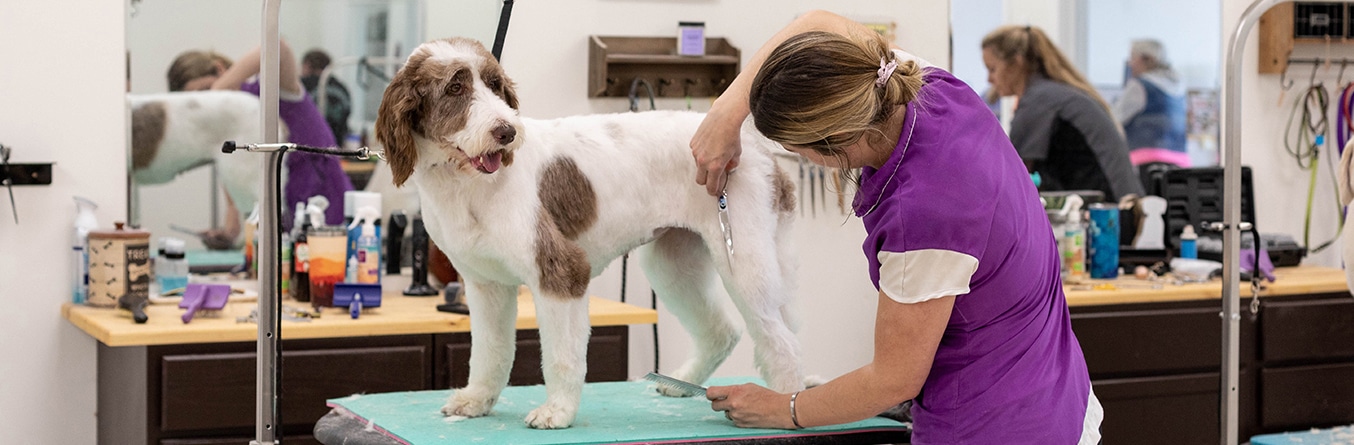
Regarding on-site practice access, Cosmos Pet Grooming Academy provides structured hands-on training within purpose-built facilities designed to simulate real salon environments. The program schedules supervised grooming shifts, balancing student progression with client flow to guarantee repeated application of core techniques. Community access is facilitated through curated outreach events and low-risk client appointments that expose learners to diverse coat types. Practice partnerships with local shelters and small businesses expand case variety and create measurable competency milestones. Instruction emphasizes procedural efficiency, sanitary protocols, and iterative feedback cycles from instructors and peers. Attendance logistics, booking systems, and remediation pathways are defined to maximize practice density. The result is a pragmatic, innovation-oriented model that prepares trainees for immediate integration into professional grooming workflows.
Equipment and Workspace Quality
Building on structured on-site practice, assessment of equipment and workspace quality examines whether tools, layout, and maintenance protocols support efficient, sanitary instruction and real-world salon standards. The review evaluates equipment durability across clippers, tables, dryers, and sanitation devices, measuring lifespan expectations, serviceability, and replaceable components. Layout analysis addresses workflow optimization, safety zones, and scalable station configurations that enable iterative learning and innovation adoption. Workspace ventilation is inspected for air exchange rates, filtration, and odor-control integration to mitigate allergens and pathogen transmission during demonstrations. Maintenance schedules, documented cleaning protocols, and parts supply chains are reviewed for continuity. Findings emphasize measurable performance criteria and actionable upgrades to align academy facilities with professional salon benchmarks and emerging industry technologies.
Instructor Support and Student Feedback
Frequently, instructor responsiveness at Cosmos Pet Grooming Academy is a key determinant of student progress. Instructor support is structured, with clear channels for mentor responsiveness via scheduled consultations, targeted feedback on practical submissions, and concise email replies. The academy documents expectations for response times and escalation procedures, enabling learners to plan iterative skill development. Peer critiques are facilitated through moderated forums and timed review cycles, promoting rapid refinement of technique and fostering collective problem-solving. Feedback emphasizes measurable outcomes, corrective actions, and reproducible workflows rather than subjective praise. For innovators seeking scalable instruction, the system integrates rubric-driven assessments and video annotations to accelerate competency acquisition. Overall, support mechanisms prioritize reliability, actionable input, and continuous improvement without distracting administrative overhead.
Pricing, Scheduling, and Certification
Having outlined the academy‘s structured instructor support and feedback mechanisms, attention shifts to how those services are packaged, scheduled, and validated through credentials. Pricing models emphasize tuition flexibility and modular fees; cohorts and à la carte modules allow cost control while preserving curriculum integrity. Payment plans are transparent, with staggered options tied to completion milestones. Scheduling prioritizes appointment availability and predictable session length, balancing intensive blocks for hands-on labs with shorter virtual check-ins. Certification follows competency-based assessment, digital badge issuance, and optional pro-level transcripts.
- A compact intensive week: tight session length, high instructor contact, limited slots.
- Modular pacing: extended appointment availability, spread-out modules, ease of payment plans.
- On-demand refreshers: short sessions, tuition flexibility, micro-credentials.
Who Each Format Is Best For
Who benefits most from each delivery format depends on time availability, learning goals, and risk tolerance. The online format suits pet owners and beginners who require flexible scheduling, bite-sized modules, and low upfront cost; it supports iterative practice and remote feedback but limits hands-on supervision. In-person delivery favors professional handlers and career switchers seeking intensive, supervised skill acquisition, real-time correction, and industry-standard equipment exposure. Hybrid approaches attract innovators who value scalability plus tactile mastery, enabling asynchronous theory with scheduled lab days. Decision criteria should prioritize competency benchmarks, portfolio development, and credentialing pathways. Institutions and learners should match format to measurable outcomes: basic maintenance skills via online; advanced technical proficiency and client-ready certification via in-person or blended pathways.
Conclusion
Cosmos Pet Grooming Academy presents viable online and in-person pathways, each with distinct strengths. The in-person program provides structured facilities and immediate hands-on supervision, while the online option offers flexible pacing and thorough theoretical modules. Prospective students should weigh learning preferences, access to practice animals, budget, and certification needs. For career-focused trainees requiring intensive practical experience, in-person instruction is preferable; self-directed learners seeking convenience may find the online format sufficient.